In his latest opinion piece, CEO of Coastline Allister Young talks about what came out of the Cornwall Housing Summit
A couple of weeks ago I took part in the Cornwall Housing Summit. It brought together local government, social housing providers, private developers, academics and community groups to talk about one simple question: how do we deliver more of the right homes, in the right places, in a way that supports strong communities and the Cornish economy?
The focus of the event was to bring people together, not for a talking shop, or to point fingers and apportion blame, but to try to generate ideas and practical actions.
As one of the speakers I was asked to talk about the housing ‘market’ in Cornwall. To give a local perspective of the current situation, and how it impacted on people’s views of what their future might be.
As a starting point, I wanted to consider what people think about housing. Over the past few years, something important has changed. People used to think that if you didn’t have the home you needed, it was your own fault. There is now much wider recognition that the housing market isn’t fair. You cannot simply work harder or try harder and expect secure, affordable housing to follow. In Cornwall especially, the gap between local incomes and local housing costs is now well understood.
That shift in understanding is, in many ways, positive, because people are blamed less for things that are outside their control. But it has a side effect. Fatalism. When people look at their housing options, they often see very few.
For someone on a median wage in Cornwall, buying a home is out of reach in almost every part of the county. Renting on the open market is possible in some places, but often only by spending far more than is considered affordable.
And social housing, while absolutely vital, is under such pressure that the chances of being housed depend heavily on very high levels of need. Thousands of households are on the housing register. The vast majority of homes that become available go to people with the most urgent needs, as they should. But that means people who are in genuine housing difficulty, yet not at crisis point, can wait years or decades.
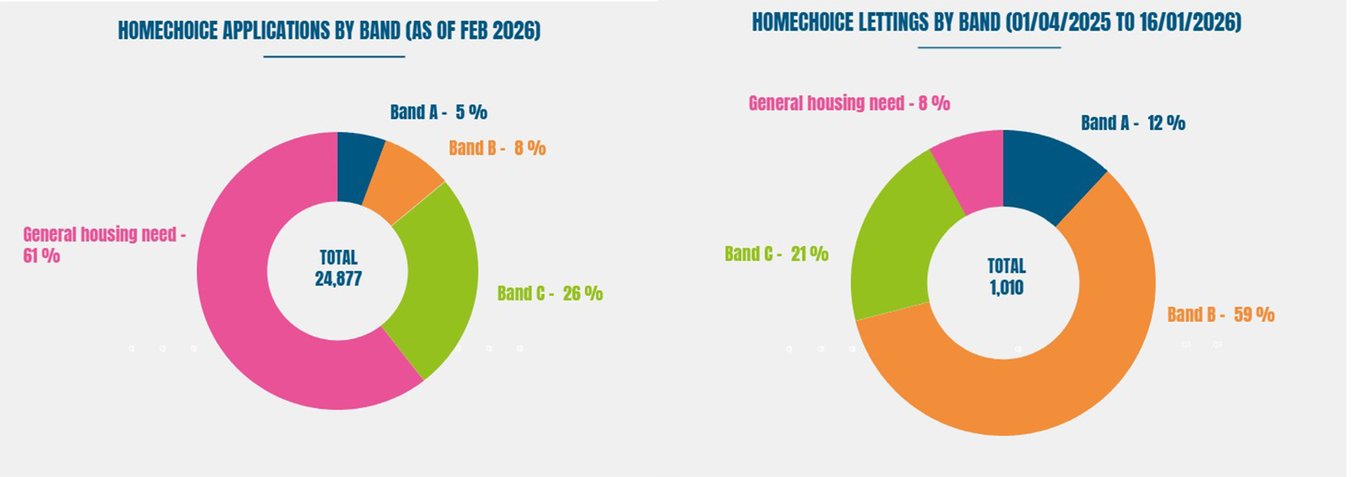
This is shown in the two pie charts below. Bands A and B on Homechoice represent the starkest of housing need, and make up 13% of households. Band C represents people who are still in significant housing need, potentially at risk of homelessness. But 71% of lettings go to people in Band A and B, with only 1 in 5 people in Band C being successful. And if you are in Band D, in housing need, struggling to find a home you can afford to rent on the private market, you make up 61% of the waiting list, but only 8% of the lettings.
The end result is that there are only 10 towns/parishes in Cornwall where the average wait for social housing is less than 10 years, seven where the wait is over 100 years, and the average is 35 years.
That is why so many people feel stuck and feel fatalistic about their futures. If you are working, contributing, raising a family, but stuck paying too much in rent or living somewhere insecure, it is not hard to see how frustration turns into disengagement.
This matters for all of us. It matters because housing stress affects physical and mental health. It matters because it makes it harder to recruit and retain people in key services, or for growing businesses. And it matters because when people lose hope that things can improve, their trust in institutions and systems falls away.
So what do we do about it?
As well as trying to build as much social housing as we can, one of the most important things is to consider how we talk to people about housing. It is important that we are honest about the scale of the challenge, but we also need to talk about solutions and not just problems. That is why Coastline adopts a positive approach in how we talk about housing in Cornwall, to try and inspire hope.
It is also important to share good news stories, to demonstrate that progress can be made. One good example of that is the progress that has been made here in Cornwall. Somewhat remarkably, Cornwall has beaten the national trend of a decline in the proportion of homes that are social housing.
In Cornwall we increased from 12% to 13% the proportion of homes that are social housing, compared to a national decline from 18% to 17%. That 1% might seem small, but it represents about 3,000 homes, about 7,000 people. That's 7,000 people who were homeless, at risk of homelessness, maybe even some of those people on a median wage who are struggling, who now have a safe, secure, affordable home to call their own.
Coastline has played a key role in that success story, and it is part of why I feel proud of the work Coastline does. We know we will not end the housing crisis overnight. But every new home, every improved service, every partnership that works a bit better, makes the problem smaller.