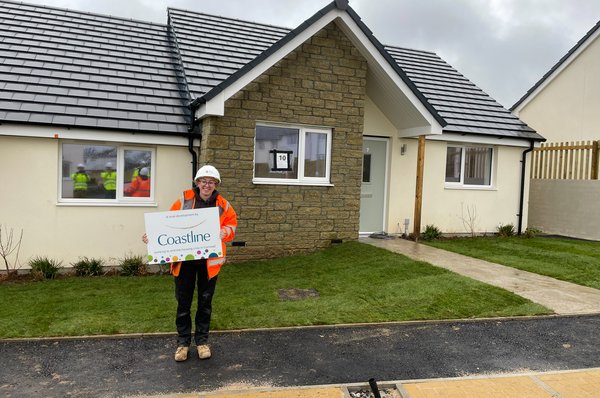
I recently spent some time visiting three of our new development schemes across Cornwall. Despite the weather, it was one of those days that really reminded me why our work matters.
Together with colleagues I went to East Taphouse, where we are delivering 22 new social rent homes, and Dobwalls, with a further 24 social rent homes. We also spent time at Penzance, a larger mixed tenure scheme of 77 homes, including shared ownership, affordable rent and rent to buy.
Thirty-three of those homes are now complete, with the remaining homes not far behind. When homes reach this stage, you stop seeing plans and programmes, or what was there before we started work, and you start imagining people moving in and getting on with their lives.
Being on site also reminds you just how much skill, care and professionalism goes into building new homes. My day out fell in between New Homes Week (which ran from February 2-8) and Women in Construction Week (which runs from March 1-7), so the timing feels right to reflect on both.
At Dobwalls I met the site manager - she knew the site inside out and spoke with real pride about what was being built. She was a great example of someone who is passionate about housing and construction, and a reminder of how important it is that our sector continues to attract and support a wide range of people.
Ultimately, the reason our work matters so much is simple. Homes change lives. A secure and affordable home provides stability, dignity and the ability to plan ahead. The National Housing Federation’s research shows that housing underpins health, wellbeing, employment and education.
It also shows the scale of the challenge. Their research suggests that England needs around 90,000 new social rent homes each year for at least a decade to meet existing need. When that level of supply is not there, pressure builds everywhere.
That pressure has real consequences. The NHF’s research has shown that building social housing delivers a significant net benefit to society and the economy, measured in tens of billions of pounds, largely because it reduces homelessness, eases pressure on health services and supports people into work.
When we do not build enough homes, we see the opposite effect. Scarcity increases competition, frustration grows, and unhelpful narratives and urban myths start to take hold.
Which brings me to one of the urban myths that circulates persistently in Cornwall. There is a recurring rumour in Cornwall that new social housing is not for local people. That it is sold to Birmingham or Manchester city councils. In reality, all new social homes in Cornwall are allocated to people with a local connection.
That is how the system works. Our scheme at Penzance is an example. Each of the 77 households that move in will either have a very local connection to Penzance, or have a connection to Cornwall and be in severe housing need.
But while it is important to dispel the urban myths about how social housing is allocated, I also think it is important to remember that Cornwall is not an island. People from Cornwall have travelled and settled all round the world over the years.
I think that’s a good thing. I believe people should be able to move to different places to build their lives, pursue opportunities and support their families.
That kind of movement is positive for individuals and for society as a whole. Supporting local need and recognising the value of mobility are not opposing ideas. They are part of a balanced and grown-up conversation about housing.
Which brings me back to what struck me most. Coastline keeps building new homes in Cornwall, year in and year out. We do it even when conditions are tough and the wider system makes it difficult.
We do it because the need is real, because homes change lives, and because every new home represents a better future for someone.